 Free
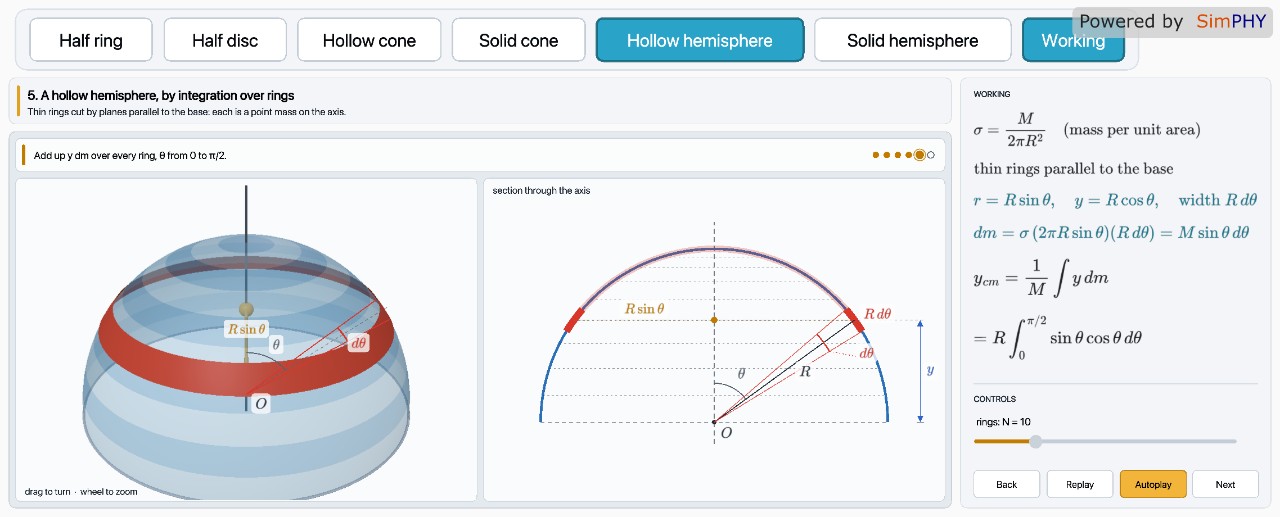
Centre of Mass Derivations for Standard Solids
Centre of MassStep through six solid bodies as their centre‑of‑mass is derived, with...
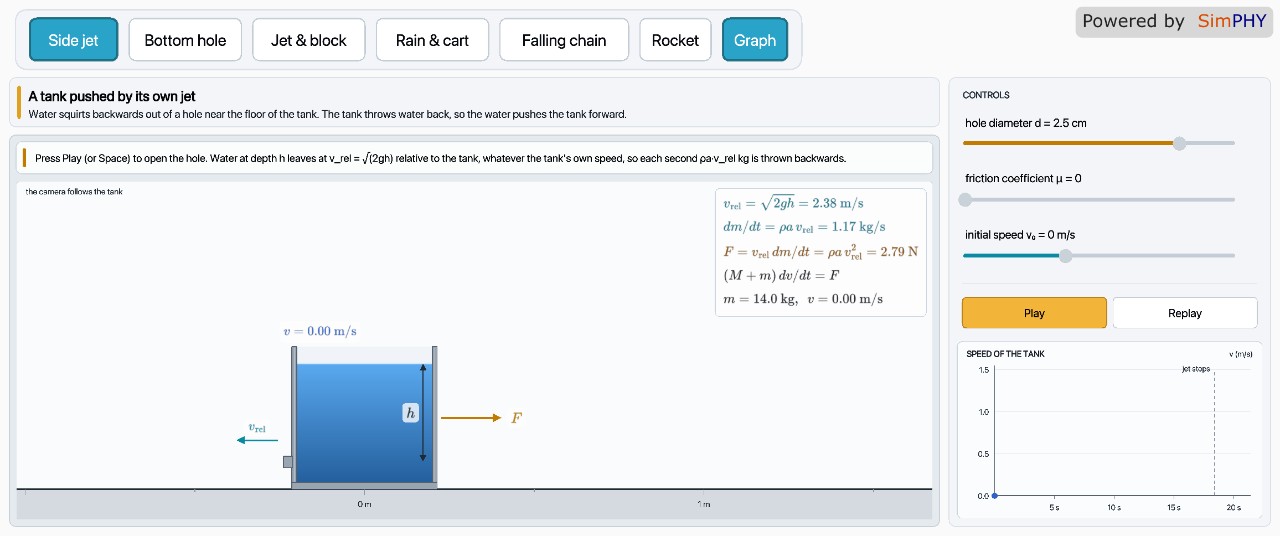
Explore how changing mass affects motion with jets, draining carts, rain‑filled carts, and falling chains.
Variable‑mass systems illustrate how a body's momentum changes when its mass is not constant. By applying the principle of conservation of momentum, students see how thrust is generated when fluid is expelled, how a rocket accelerates, and why a falling chain exerts extra force on a scale. The simulation links fluid mechanics, centre‑of‑mass motion, and Newton’s second law in real‑world scenarios.
Six interactive steps let learners watch a side‑jet tank, a draining cart, a jet striking a block, rain collecting in a cart, a falling chain, and more. Sliders on the right panel adjust parameters such as fluid density, jet speed, hole size, and friction coefficient, while graphs display force, velocity, and mass versus time. Students can compare cases where ejected fluid leaves with the vehicle’s speed versus with a different speed, observing the resulting acceleration or lack thereof.
By manipulating the controls, students develop intuition about thrust, terminal speed, and the extra dynamic term (λv²) that appears in falling‑chain problems. The activity reinforces concepts of momentum conservation, variable‑mass dynamics, and the interplay between fluid flow and mechanical motion, preparing them for advanced studies in mechanics and aerospace physics.
Free
Step through six solid bodies as their centre‑of‑mass is derived, with...
 Free
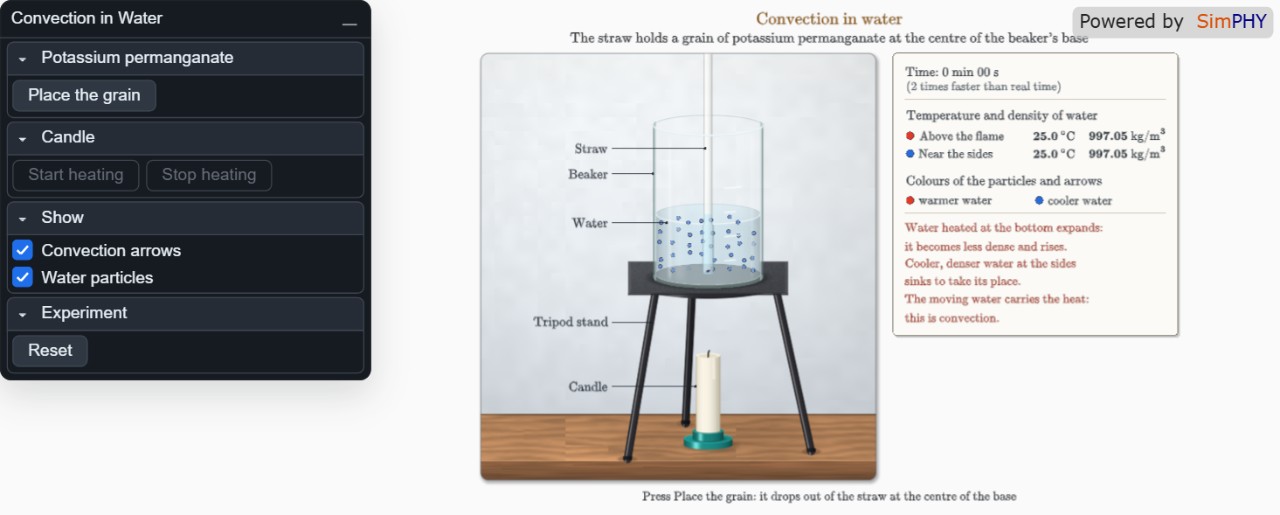
Observe heating a beaker of water produce a convection loop, shown by...
 Free
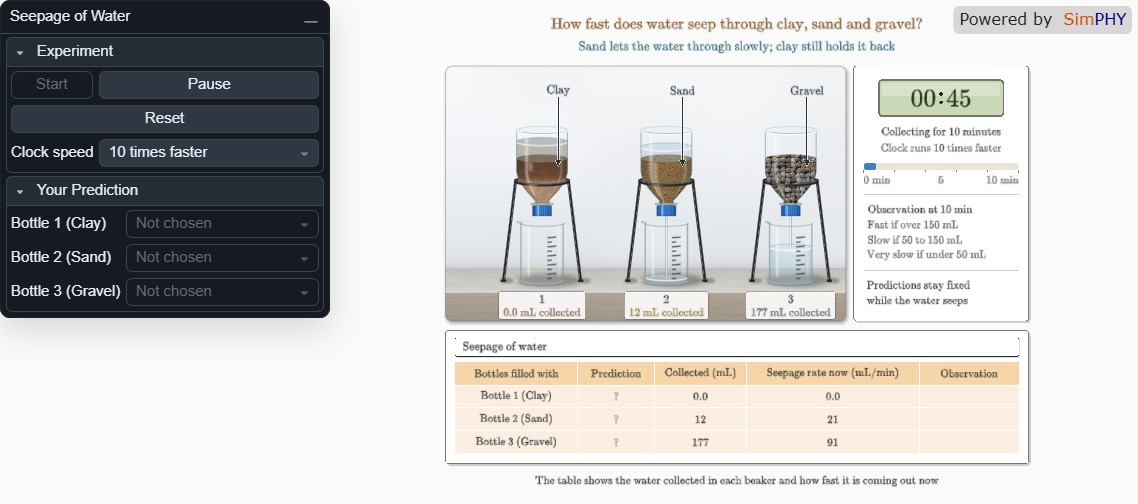
Compare water flow through clay, sand and gravel using Darcy’s law to...
 Free
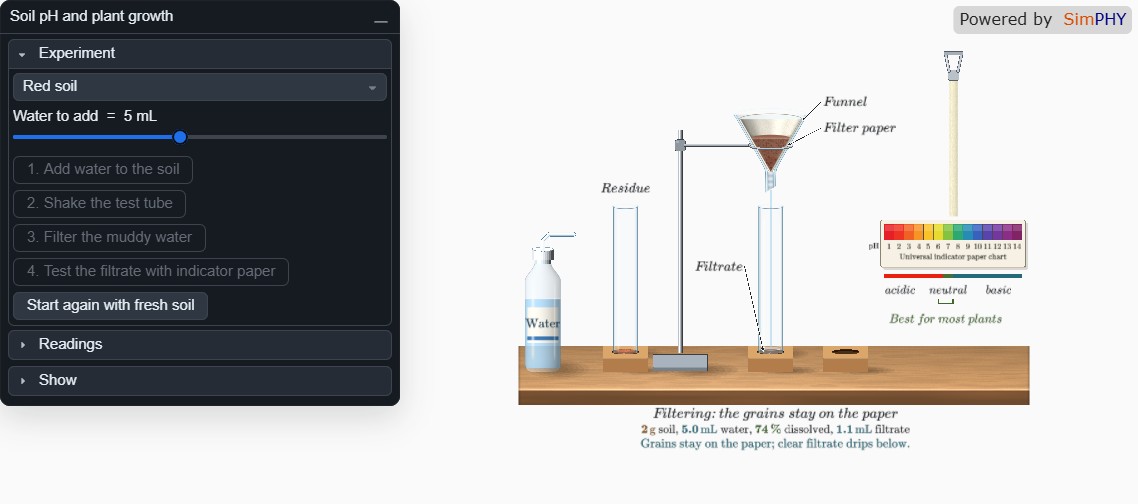
Filter soil water and dip universal indicator paper to read pH; see ho...
 Free
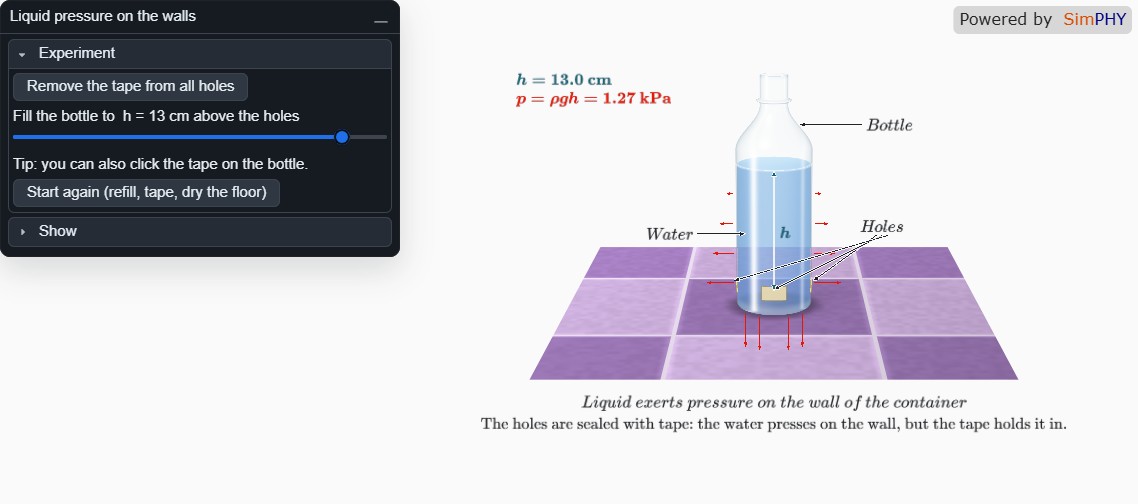
Water jets from four equal‑depth holes show that liquid pressure acts...
 Free
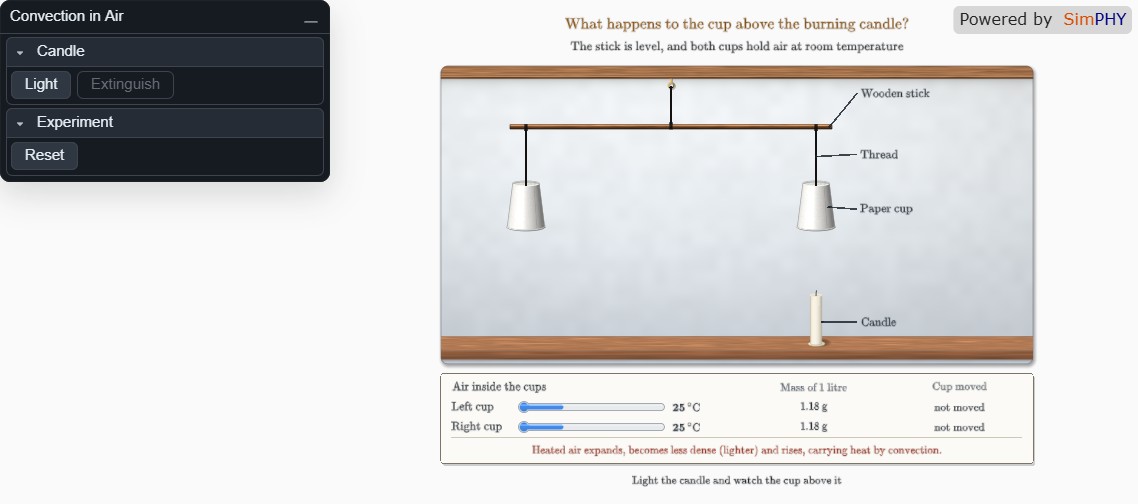
Light a candle under an upside‑down paper cup; warm air rises, lifting...