 Free
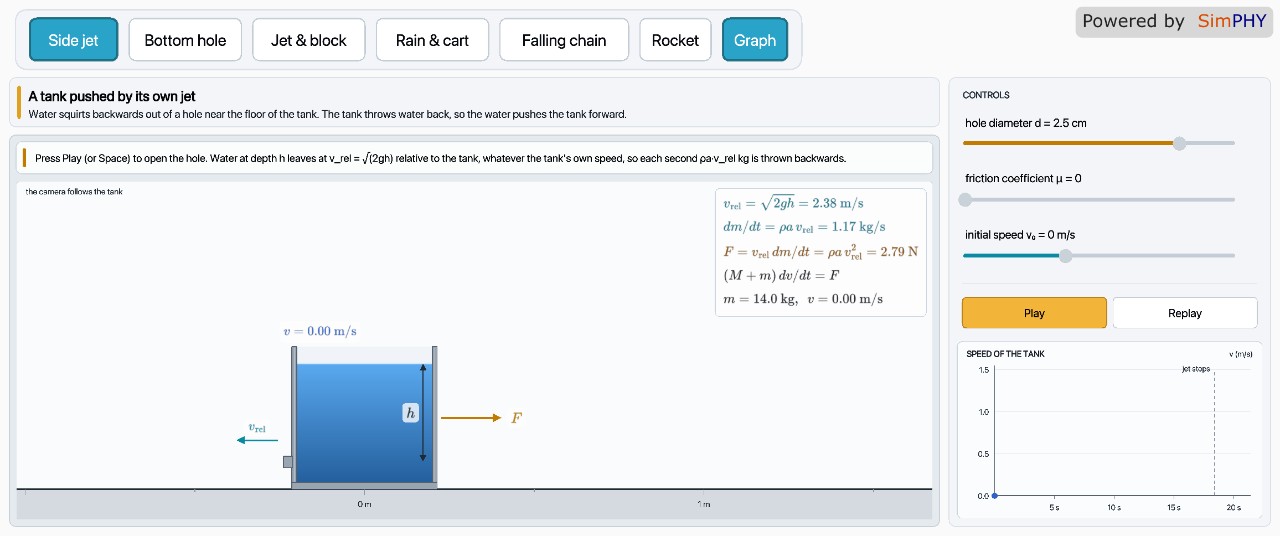
Variable Mass Systems: Jets, Rockets, and Falling Chains
Centre of MassExplore how changing mass affects motion with jets, draining carts, ra...
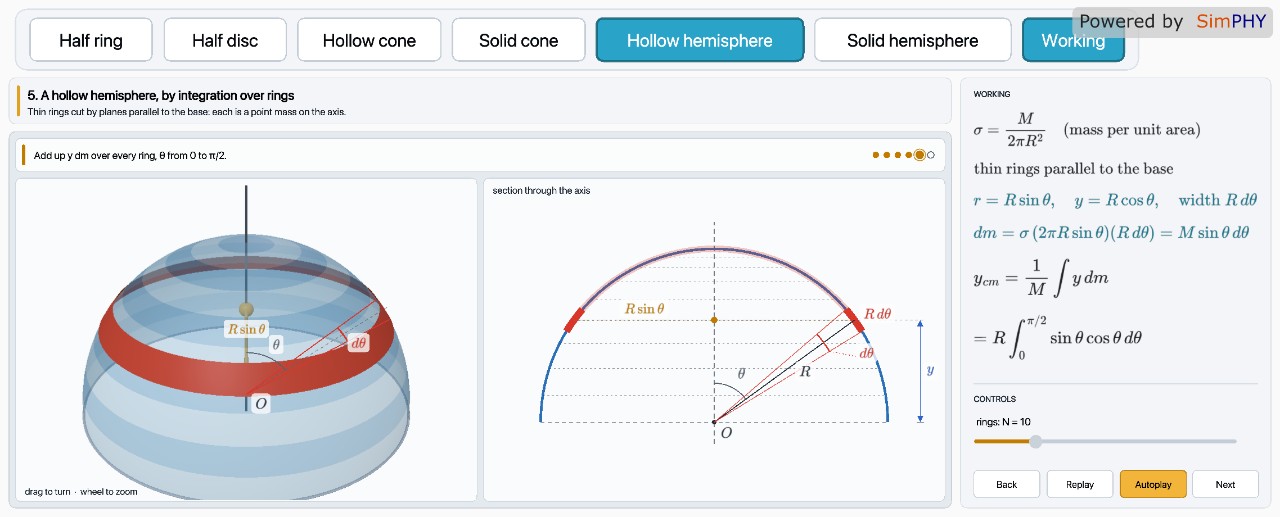
Step through six solid bodies as their centre‑of‑mass is derived, with 3‑D views and LaTeX explanations.
The centre of mass of a body is the weighted average position of all its mass elements, given by r_cm = (1/M)∫r dm. It is a fundamental concept in mechanics, helping predict the motion of objects and the stability of structures.
In this simulation six classic solids – a half‑ring, half‑disc, hollow cone, solid cone, hollow hemisphere and solid hemisphere – are presented one after another. For each shape the script builds the derivation step by step, showing the integral or geometric argument and placing the resulting point mass on a 3‑D view that can be rotated and zoomed. Users advance with Next/Back buttons, Arrow keys, or let Autoplay run the sequence; Space toggles Autoplay and Replay restarts a step.
Students observe how geometry influences the centre‑of‑mass location, compare hollow versus solid forms, and see the role of symmetry and integration. The activity reinforces calculus applications, spatial reasoning, and the physical meaning of centre of mass, preparing learners for further studies in mechanics and engineering.
Free
Explore how changing mass affects motion with jets, draining carts, ra...
 Free
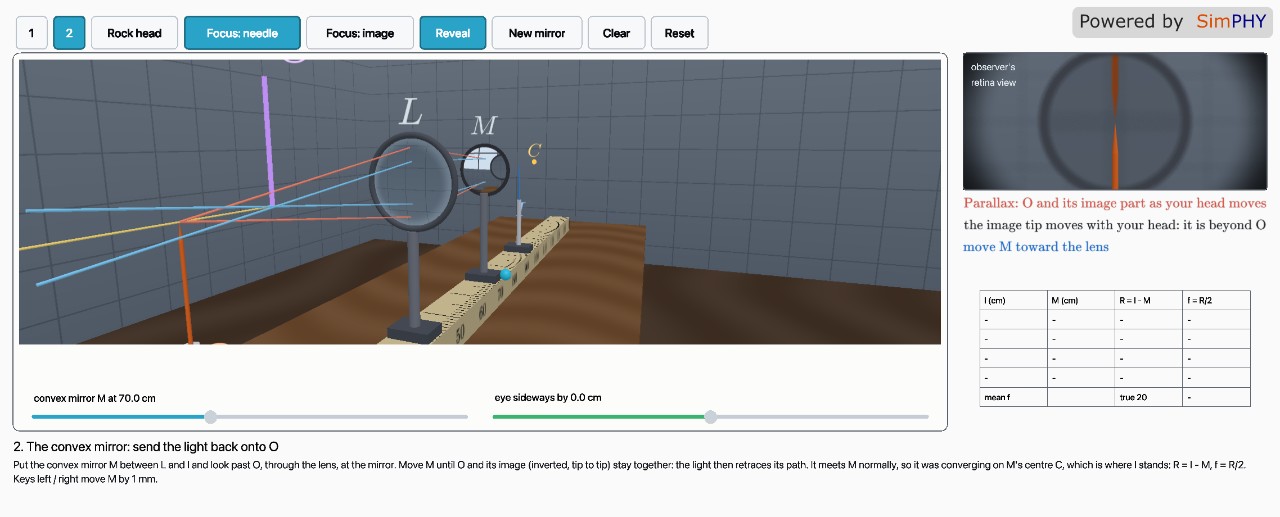
Measure a convex mirror’s focal length on an optical bench using a con...
 Free
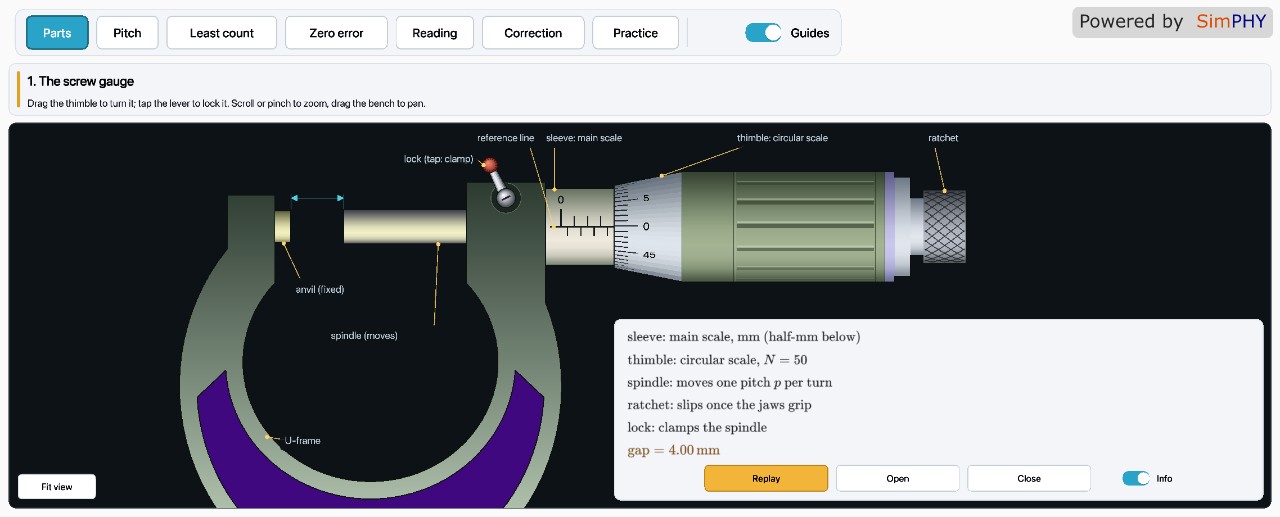
Explore a micrometer’s pitch, least count, zero error and readings thr...
 Free
Fire a cannon by setting angle and speed to hit targets in 11 levels,...
 Free
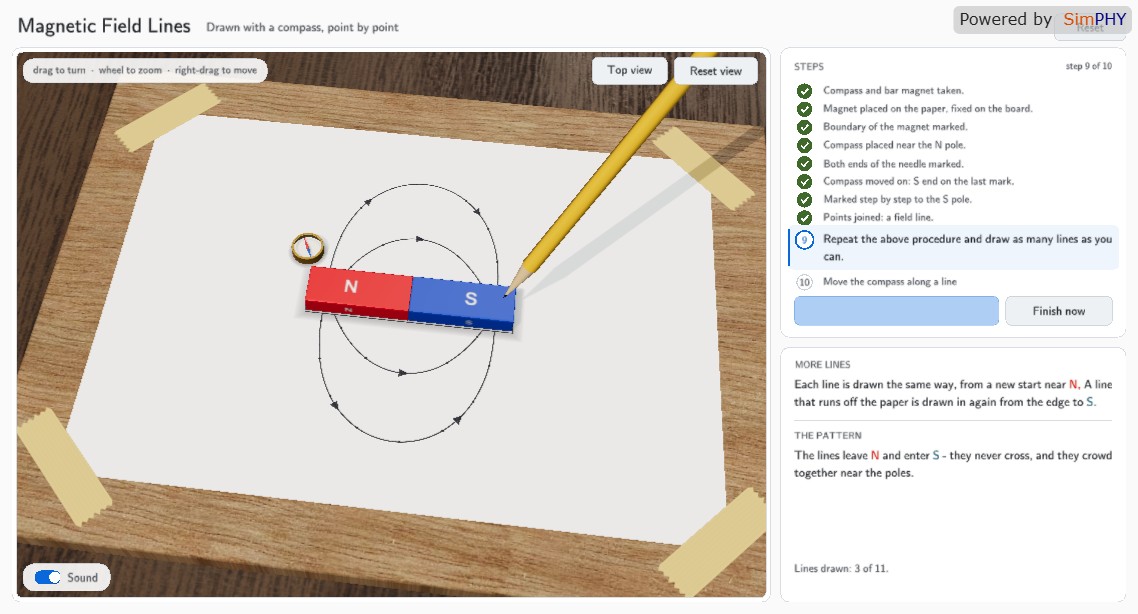
Draw magnetic field lines of a bar magnet with a compass, following NC...
 Free
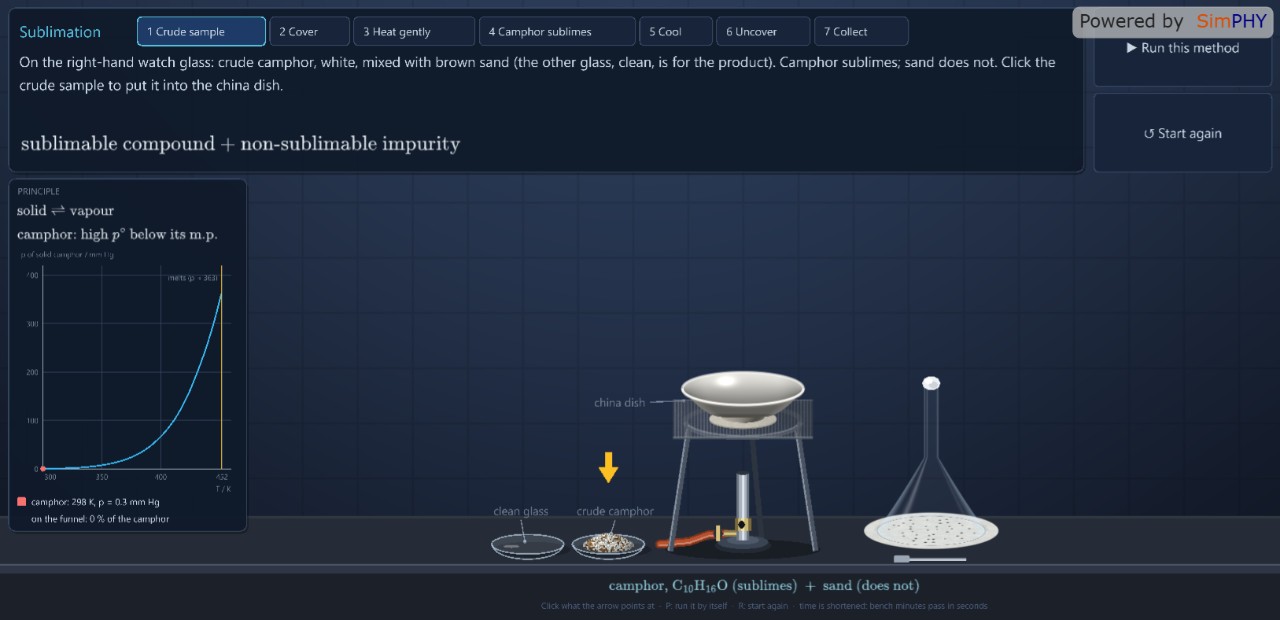
Watch camphor sublimate, condense on a surface, and leave sand behind,...