 Free
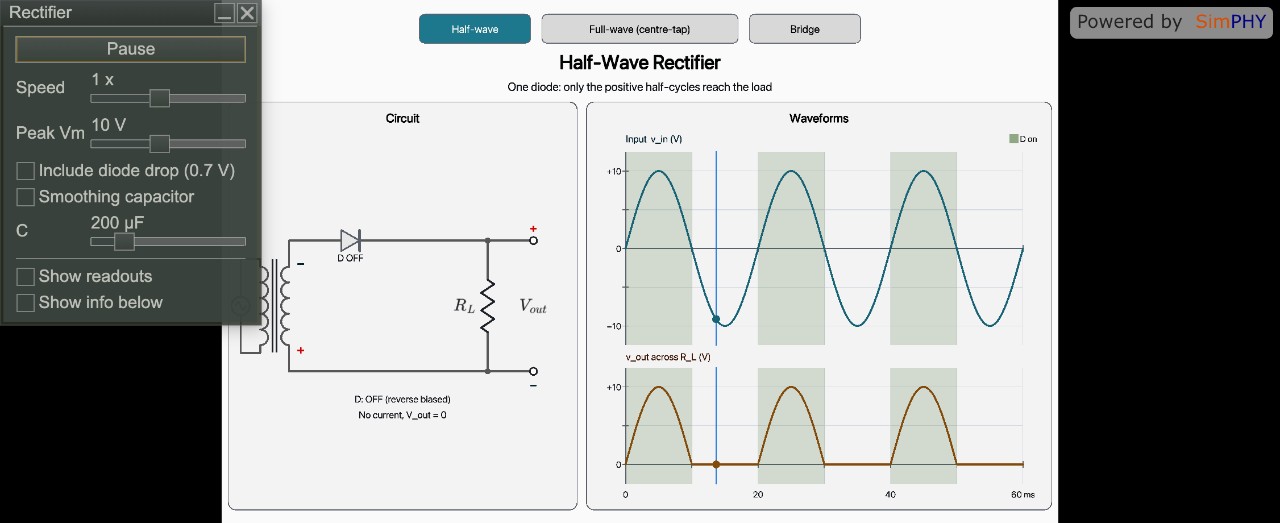
Rectifier Circuits: Half‑Wave, Full‑Wave and Bridge with Smoothing
Semiconductor ElectronicsExplore half‑wave, full‑wave, and bridge rectifiers; set diode drop, p...
Explore electron and hole flow in intrinsic, n‑type and p‑type silicon, with temperature and electric field.
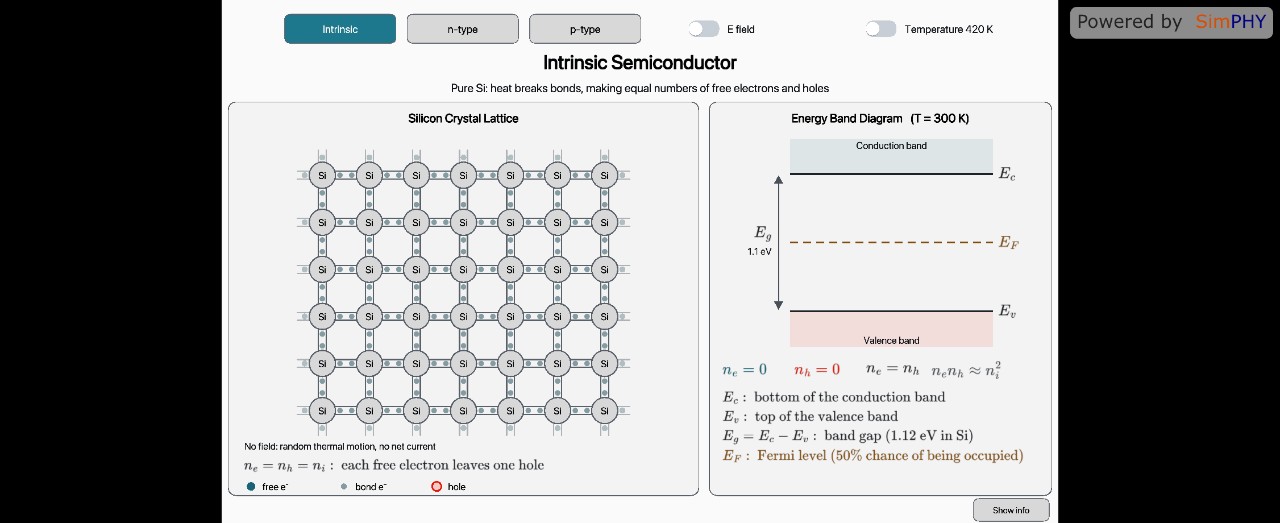
The simulation visualises a small silicon crystal lattice where each Si atom shares covalent bonds that hold two electrons. When a bond is broken by heat, an electron becomes free and the vacancy appears as a hole. In intrinsic silicon the numbers of free electrons and holes are equal, while n‑type material contains extra electrons from donor atoms and p‑type material contains extra holes from acceptor atoms, shifting the Fermi level.
Students can switch between Intrinsic, N‑Type and P‑Type tabs to see how the carrier populations differ. Two toggles let them apply a 3 V electric field across the crystal and raise the temperature from 300 K to 420 K, observing how increased thermal energy creates more free carriers and how the field drives electron and hole motion. The simulation also shows recombination events where electrons and holes annihilate at a rate proportional to their concentrations.
By interacting with the model, learners discover the quantitative relationship n·p = n_i^2, see how doping and temperature control conductivity, and develop an intuitive grasp of the Fermi level’s role in semiconductor behavior.
Free
Explore half‑wave, full‑wave, and bridge rectifiers; set diode drop, p...
 Free
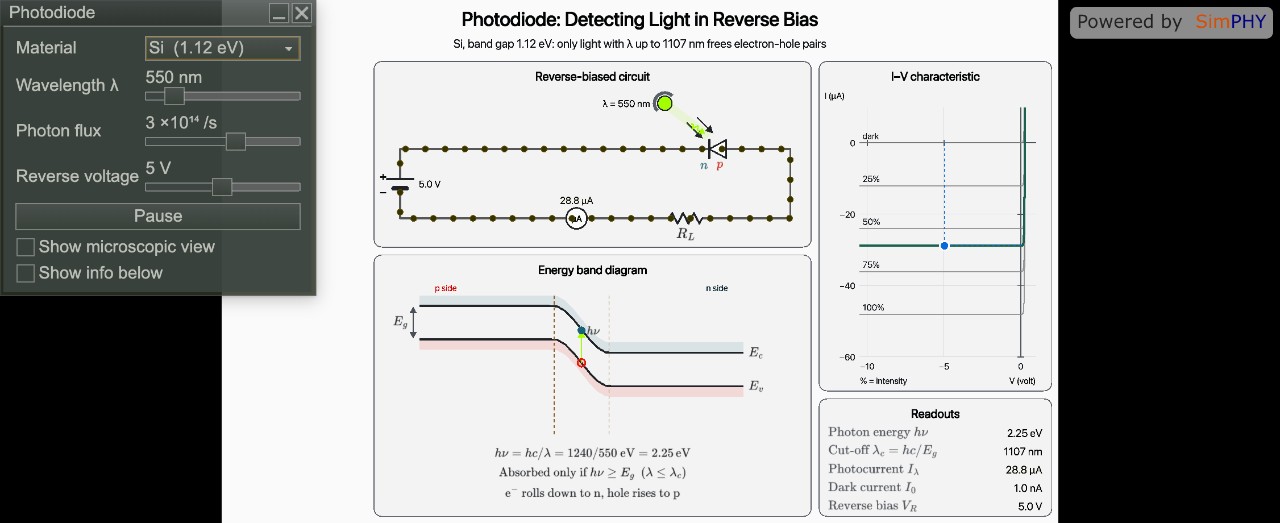
Explore how light of different wavelengths creates current in a revers...
 Free
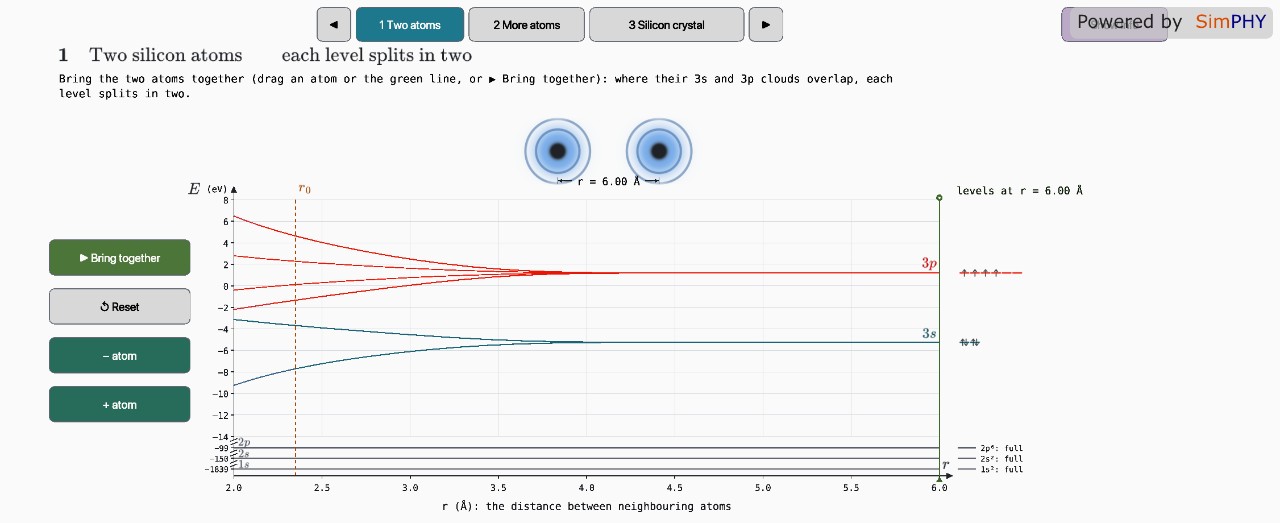
Watch silicon atom orbitals merge into energy bands as inter‑atomic di...
 Free
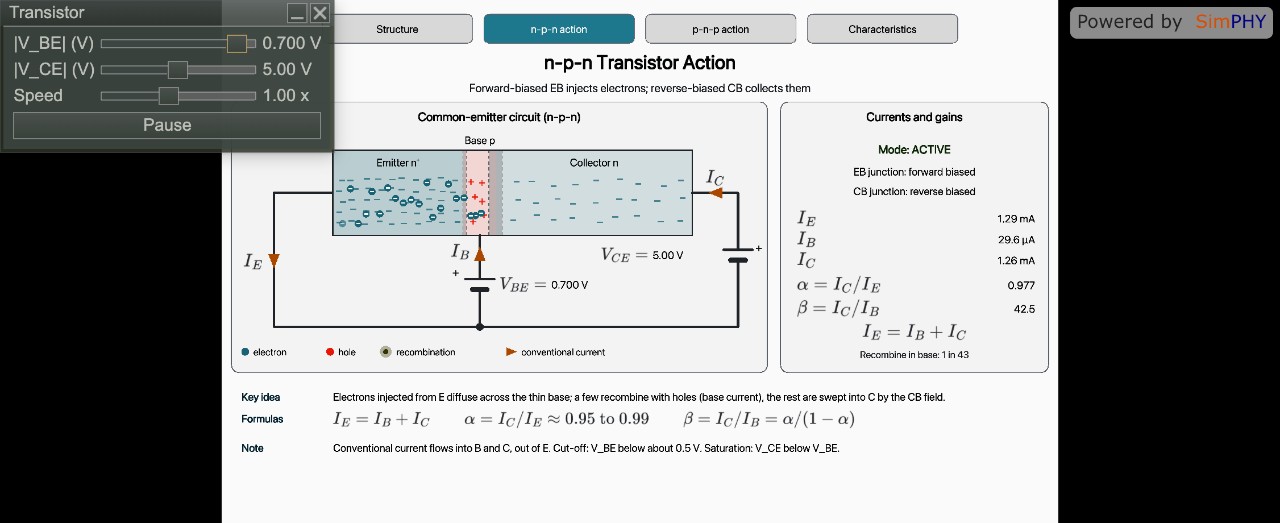
Explore n‑pn and p‑np transistor structure, watch carrier flow in a ci...
 Free
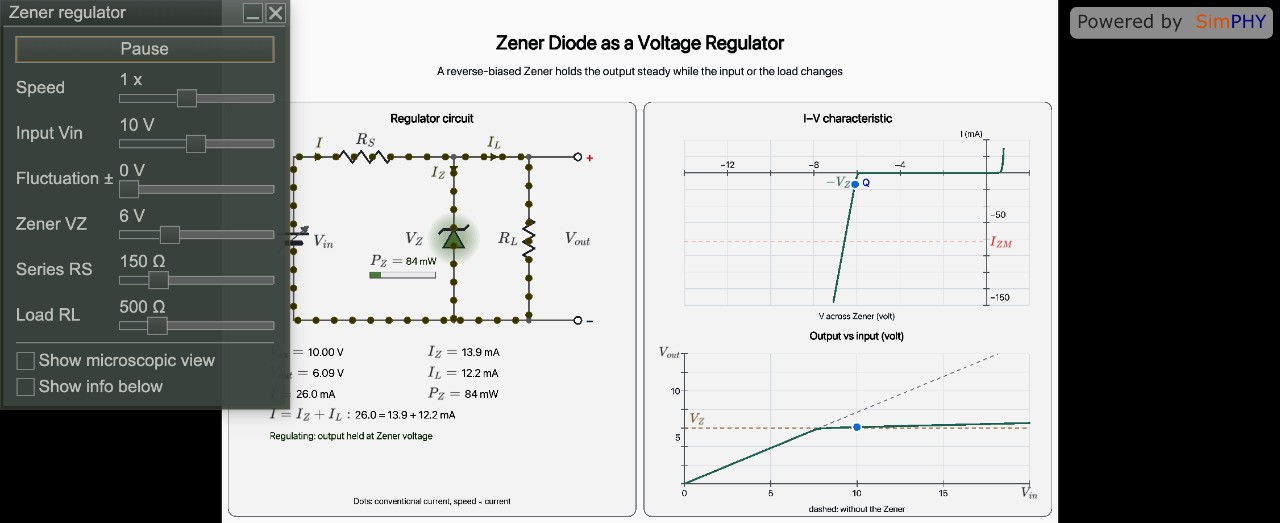
Explore how a Zener diode stabilizes output voltage while you vary inp...
 Free
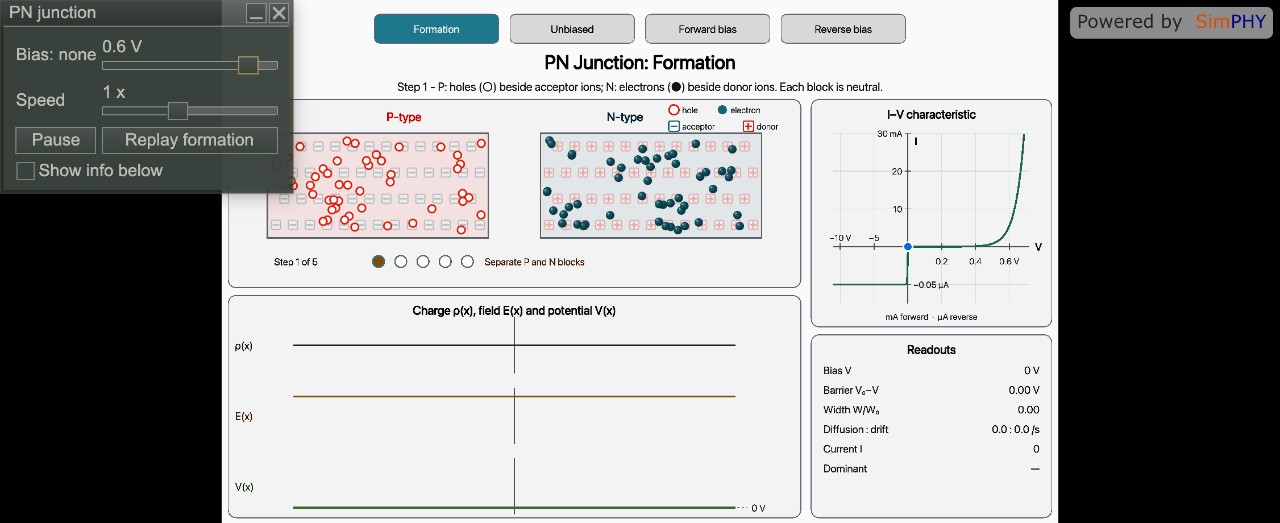
Explore PN junction formation, depletion width, and how forward or rev...