 Free
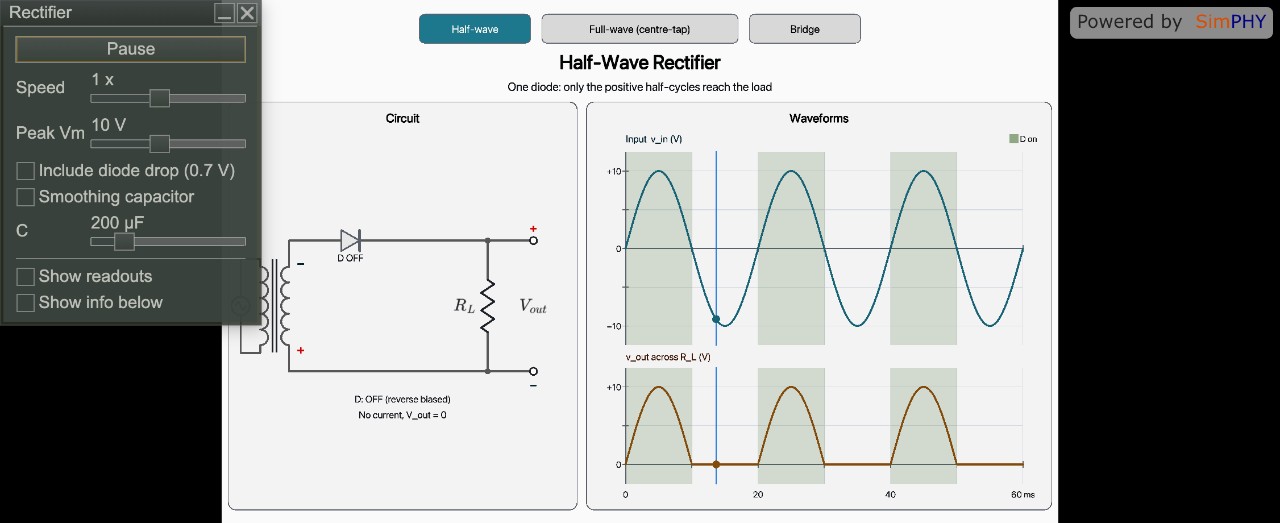
Rectifier Circuits: Half‑Wave, Full‑Wave and Bridge with Smoothing
Semiconductor ElectronicsExplore half‑wave, full‑wave, and bridge rectifiers; set diode drop, p...
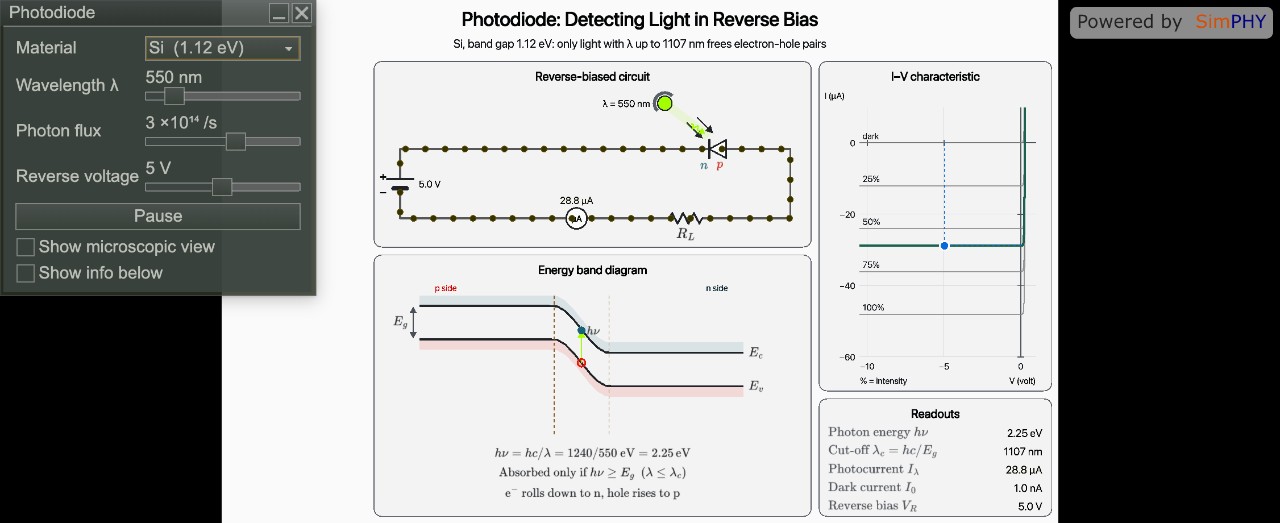
Explore how light of different wavelengths creates current in a reverse‑biased photodiode of Si, Ge, or GaAs.
A reverse‑biased photodiode is a semiconductor junction where the n‑type side is connected to the positive terminal of a battery. Photons with energy greater than the material’s band‑gap break covalent bonds, creating electron‑hole pairs that are swept by the electric field, producing a measurable current.
Students can select the semiconductor material (silicon, germanium, or gallium arsenide) to change the band‑gap, then adjust the light wavelength, photon flux, and reverse voltage. The circuit view shows the diode, load resistor, and ammeter, while an optional microscopic view displays the lattice and the photon‑induced bond breaking.
By experimenting, learners see how photon energy, material properties, and bias voltage affect photocurrent, reinforcing concepts of band structure, the photoelectric effect, and semiconductor device operation.
Free
Explore half‑wave, full‑wave, and bridge rectifiers; set diode drop, p...
 Free
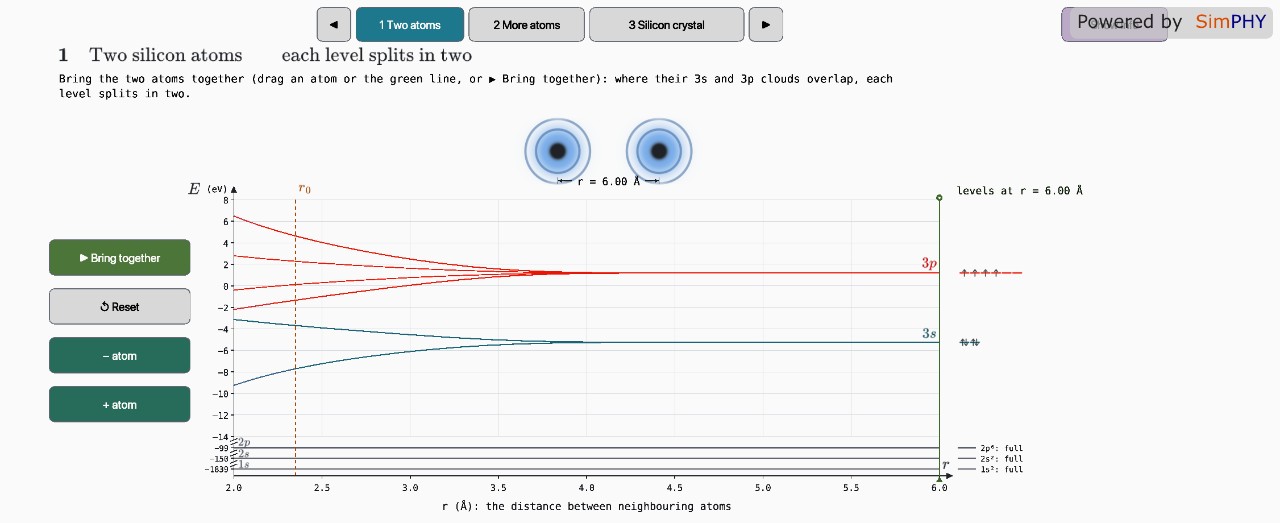
Watch silicon atom orbitals merge into energy bands as inter‑atomic di...
 Free
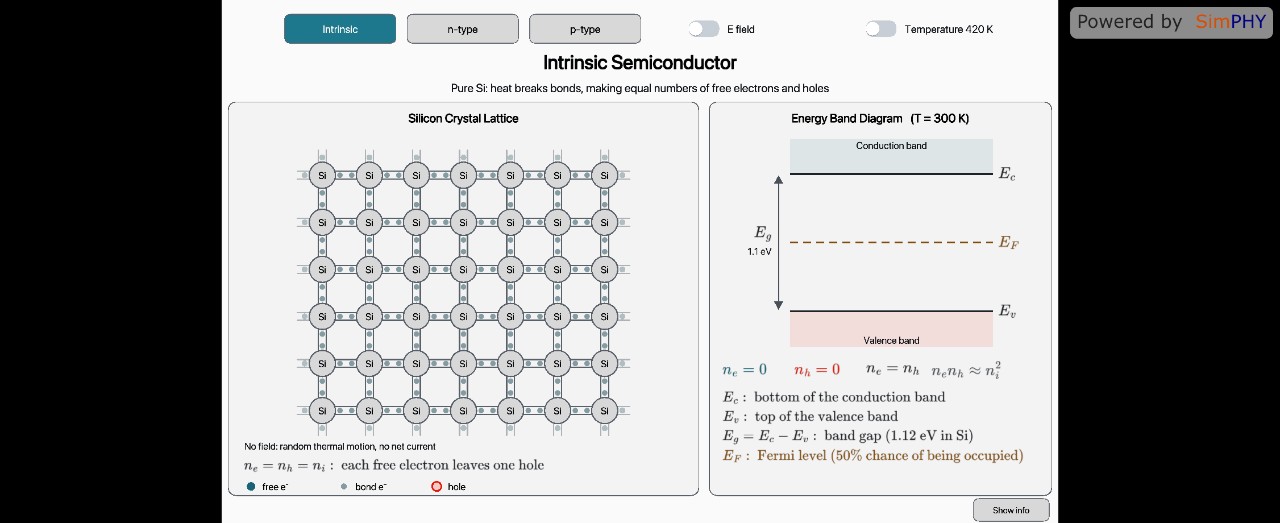
Explore electron and hole flow in intrinsic, n‑type and p‑type silicon...
 Free
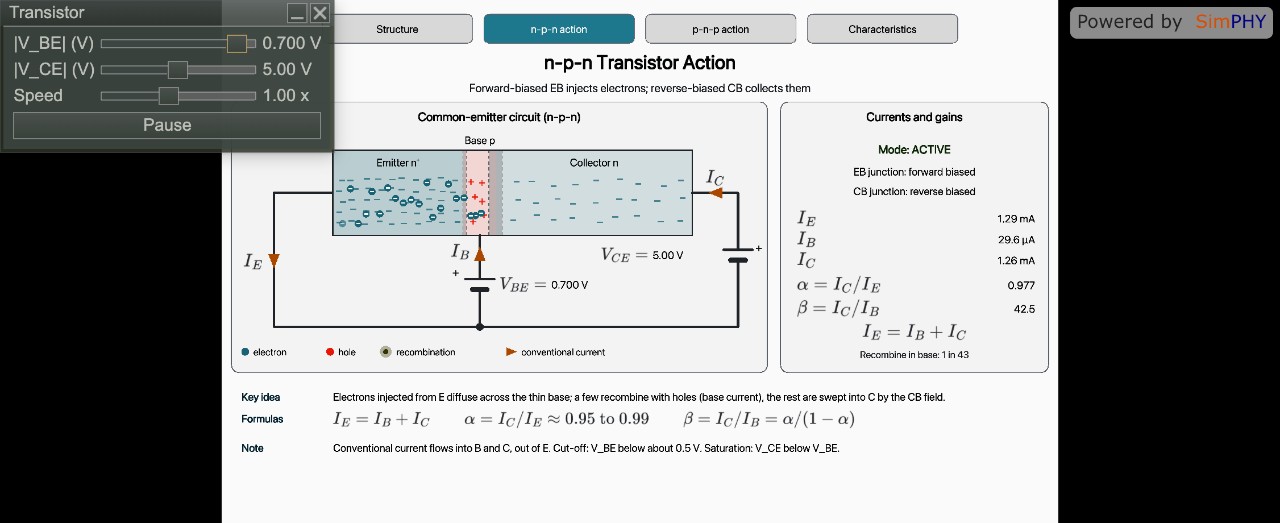
Explore n‑pn and p‑np transistor structure, watch carrier flow in a ci...
 Free
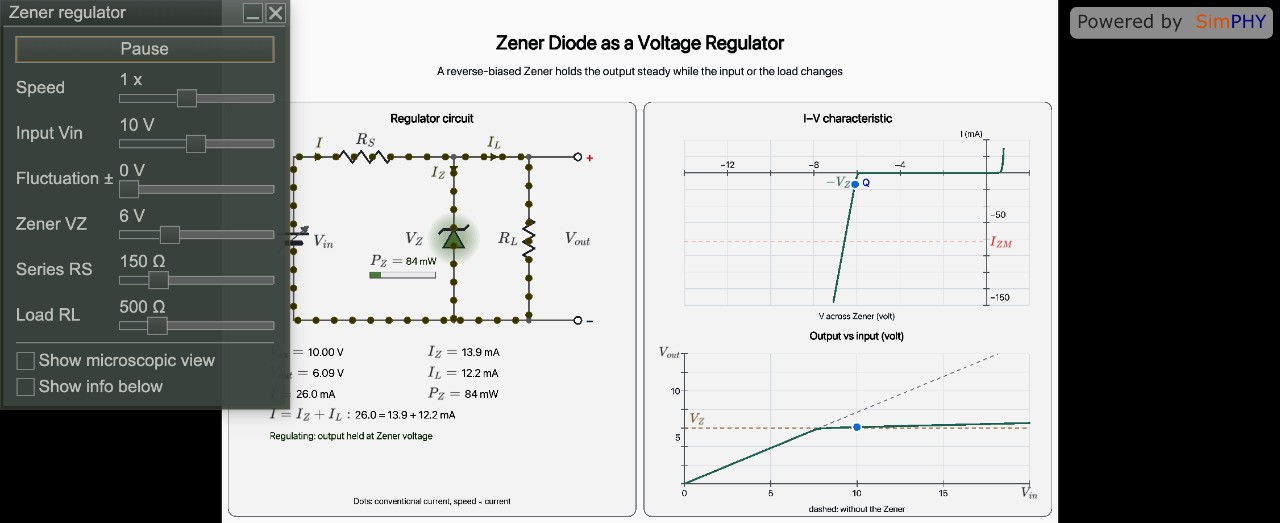
Explore how a Zener diode stabilizes output voltage while you vary inp...
 Free
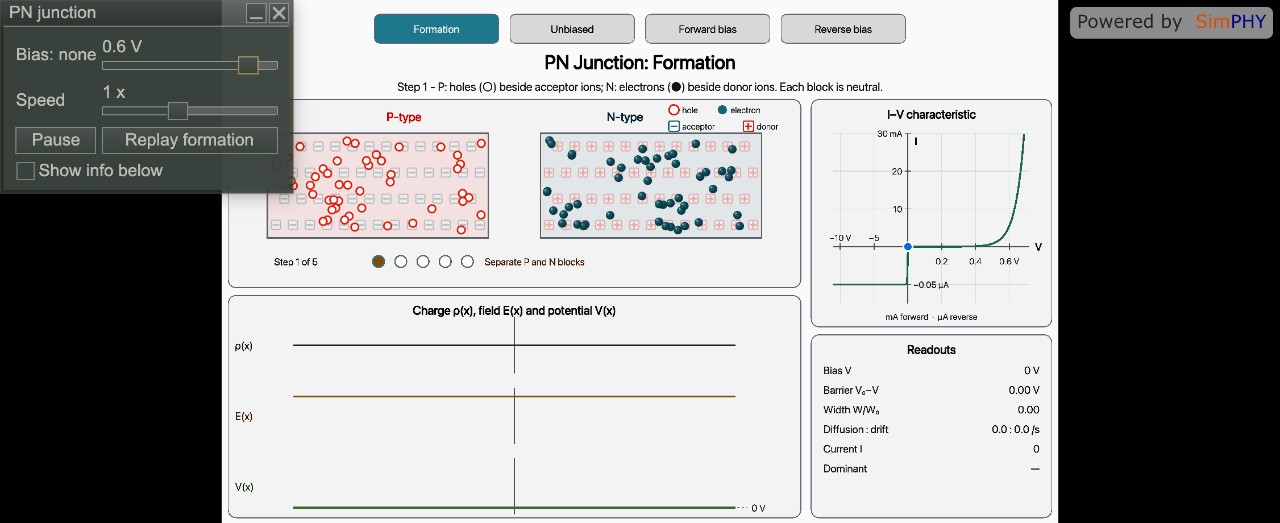
Explore PN junction formation, depletion width, and how forward or rev...